Canada’s free trade agreements (FTAs) can help your business reach new customers, lower costs, and grow internationally. We can help you understand which agreements may apply to your target markets and how to use them.
15 free trade agreements | 51 countries | 61% global GDP
On this page
How free trade agreements can help your business
FTAs make international business easier and more predictable. They can help you:
- lower costs through reduced or eliminated tariffs
- reach new customers in more markets
- strengthen your position in markets where Canada has a trade agreement
- reduce risk through clearer and more predictable rules
- move goods more easily across borders
- access supply chains more easily
- diversify your exports and reduce reliance on a single market
Whether you sell goods or services, an FTA may give you an advantage over your competition in markets where Canada has a trade agreement in place.
Canada’s free trade agreements
Canada’s free trade agreements are not all at the same stage. Some are already in force, while others are signed, concluded, or still under negotiation.
Use the map to quickly see Canada’s FTAs that are in force.
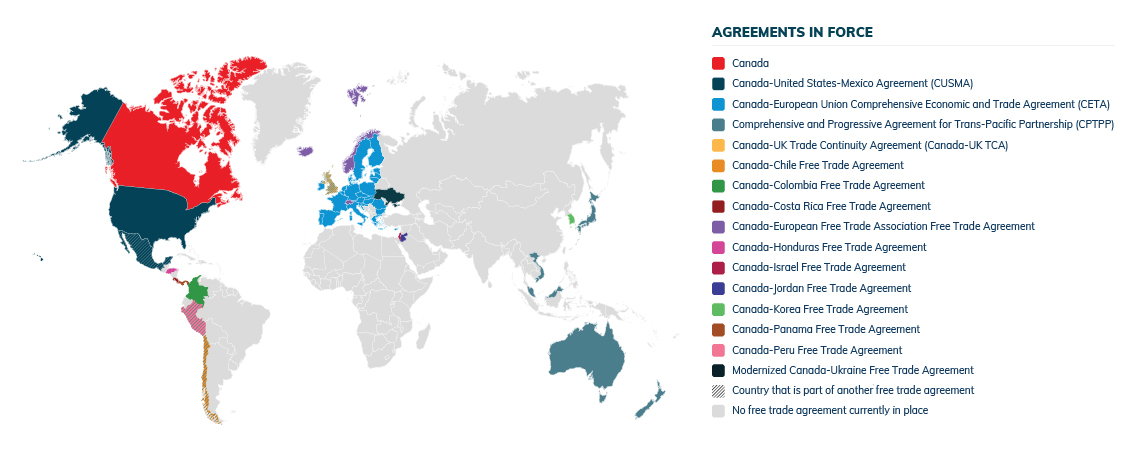
Currently in force
These agreements are in force and may already offer benefits to Canadian businesses exporting to those markets.
- Canada-United States-Mexico Agreement (CUSMA)
- Canada-European Union Comprehensive Economic and Trade Agreement (CETA) (provisional application; in force for Canadian exporters)
- Comprehensive and Progressive Agreement for Trans-Pacific Partnership (CPTPP)
- Canada-UK Trade Continuity Agreement (Canada-UK TCA)
- Canada-Chile Free Trade Agreement
- Canada-Colombia Free Trade Agreement
- Canada-Costa Rica Free Trade Agreement
- Canada-European Free Trade Association (EFTA) Free Trade Agreement
- Canada-Honduras Free Trade Agreement
- Canada-Israel Free Trade Agreement (CIFTA)
- Canada-Jordan Free Trade Agreement
- Canada-Korea Free Trade Agreement (CKFTA)
- Canada-Panama Free Trade Agreement
- Canada-Peru Free Trade Agreement
- Modernized Canada-Ukraine Free Trade Agreement (CUFTA)
Signed, not yet in force
Concluded negotiations
These agreements have concluded negotiations but are not yet in force.
In negotiations
Understanding agreement statuses
Want to know what terms like in force, signed, concluded negotiations or provisional application mean? Read Understanding Canada’s trade and investment agreement types and statuses.
FTA tools from the Government of Canada
Use these tools to check tariffs, compare markets and identify opportunities in FTA markets.
- Tariff information by country and Harmonized System (HS) codes: Find tariff information and applicable HS codes for your product.
- Canada Tariff Finder: Check tariff information for products in countries where Canada has an FTA.
- Global Bid Opportunity Finder: Search for commercial opportunities with foreign governments open to Canadian businesses.
Related resources
- Investment agreements: Explore Canada’s international investment agreements alongside its FTAs.
- Understanding agreement types and statuses: Learn what each agreement category and status means.
- Diversifying trade for Canada: Learn more about how Canada is expanding its trade relationships around the world.
Contact us
Interested in exporting to a market covered by a free trade agreement?
- Contact your regional office if you are exploring a market and need guidance
- Contact a Trade Commissioner abroad if you are already active in an FTA market and want market-specific support
- For questions about technical barriers to trade or regulations under one of Canada’s FTAs, contact Global Affairs Canada at consultations@international.gc.ca
Featured

Diversifying trade for Canada
Canada is actively expanding its economic presence around the world. Learn more about what that means, and how it benefits Canadians.

CPTPP drives growth in Asia for seafood company
Explore how the CPTPP can support exports to key markets like Vietnam and Japan.